Kept a farm - three cows, two working horses, sheep, geese and chickens.
Exiled as a kulak in March 1930.
He, very weak, worked on the uprooting of arable land. On May 16, 1934, before lunchtime, he fulfilled the daily norm for uprooting the earth and, exhausted, fell. He was picked up and brought home. They were given an exemption from work and an additional ration of bread. But this did not help. On the night of May 18, he died.
Belows is a translation of extract from article by Nikolai Tashkeev in 2024 at
https://kuzrab.ru/rubriki/obshestvo/pamyatnik-stalinu-v-novokuzneczke-net/ From the memoirs of Ivan Mikhailovich Tashkeev, born in 1924, which he wrote down before his death in 2006.
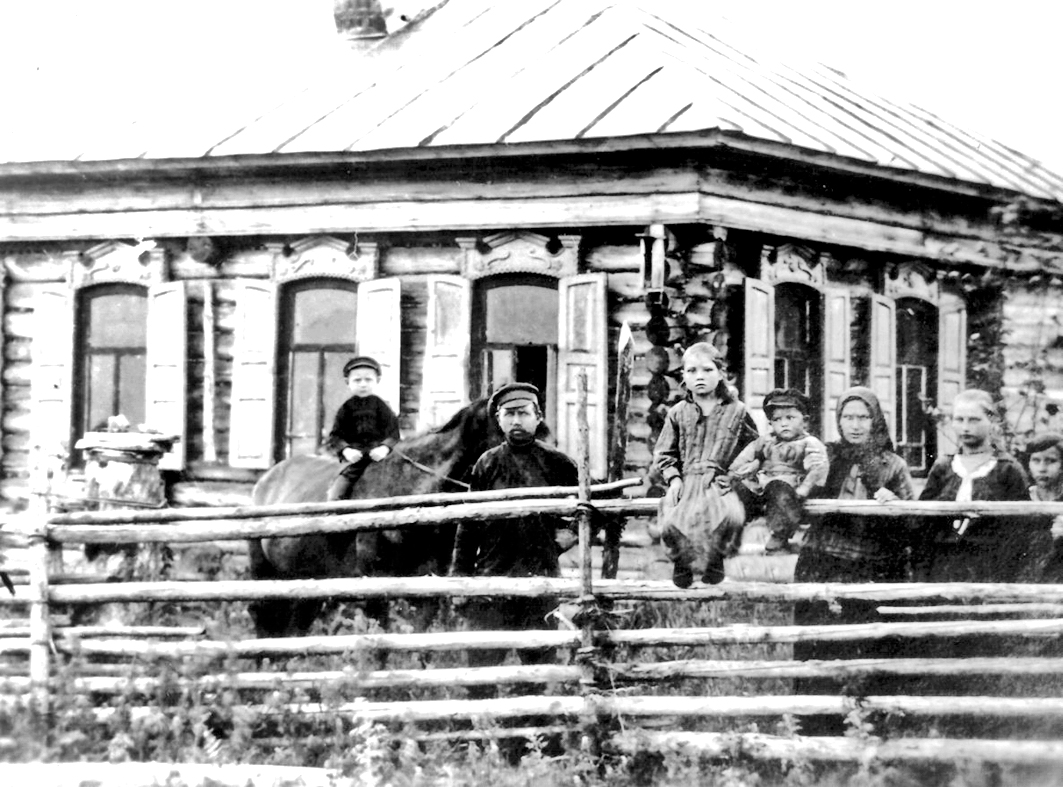
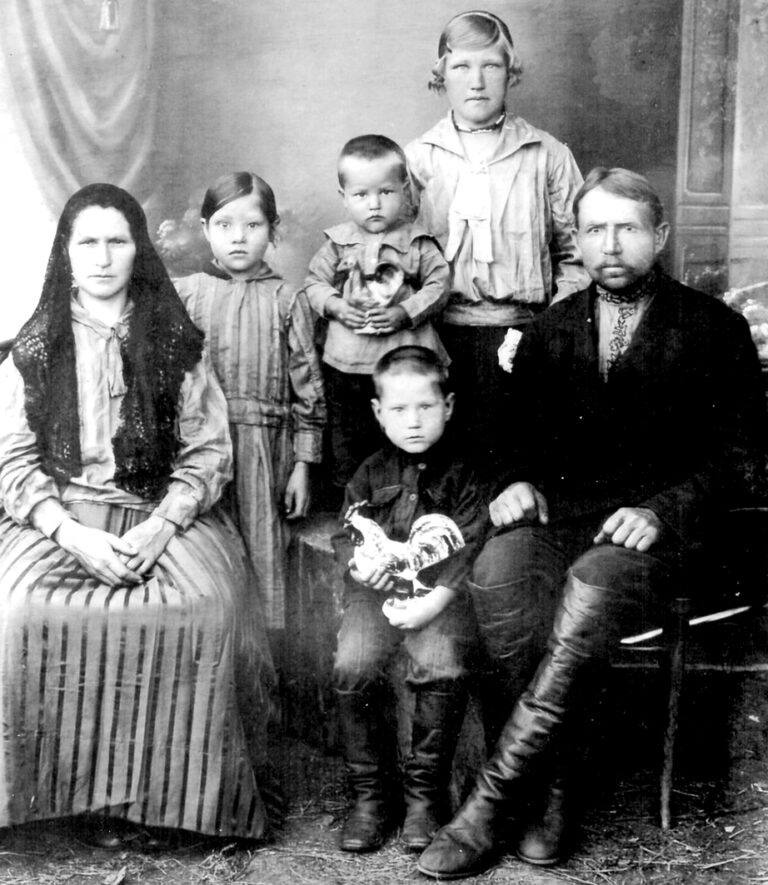
Here is this house measuring 10x6 meters, in which we all lived. The house was built on the farm of Lozhkin (the village of Karagayskoye, Chelyabinsk region) around the period of 1923 - 1929. In the picture, from left to right, his father's favorite Vanya is on horseback. Father, Mikhail Andreevich, Natasha, Victor, mother, Anna Gervasievna, Anna (older sister) and Lyuba. The photograph was taken in 1929 (approximately, but not later). According to his late mother, after the end of the Civil War, a plot of land was allocated, on which they sowed grain, planted potatoes and vegetables. They kept a farm - three cows, two working horses, sheep, geese and chickens. They lived by it. The workers were only their own - the hands of his father, mother, sisters Anya and Lyuba.
And so, on the basis of the Decree of the Council of People's Commissars and the Central Executive Committee of the USSR of 01.02.1930, somewhere in early March 1930, people drove up to the house (they were even armed) and gave the command to gather for eviction. Then tears, crying and howling, lamentations and complete panic began. Some of the things were collected and tied into knots. Everything was loaded into a sleigh and we were taken away from our home. I was only five years old then, Victor was three years old, Natasha was nine. Thus began the start of our life's journey.
On November 7, 1929, an article by Stalin appeared in the newspaper Pravda No 259 entitled "The Year of the Great Turning Point." In this article, 1929 was declared "the year of a great turning point in the development of our agriculture." It is this article that is recognized by most historians as the starting point of "complete collectivization." It was in this article that Stalin openly declared that the kulaks as a class should be eliminated in the country.
Outright arbitrariness, lawlessness, abuse, mockery and mockery of people were happening everywhere. Justice was unattainable. In 1998, a document was found in the Chelyabinsk archives - "Protocol No of the 19th closed meeting of the Presidium of the Troitsk District Executive Committee of 21.03.1930", which says: "After a thorough check of those actually evicted in the district, it turned out that in the districts of Magnitny and Verkhneuralsk, 12 families were illegally deported, contrary to the decisions of the OKR, namely?" Well, they wrote that 12 families were expelled illegally, so what? Was someone returned home? Did you apologize to someone? Of course not.
"The forest is cut down - chips fly" - Stalin's favorite expression. As it turned out, the OGPU commissioner Bychkov simply added my father's name to the already printed and approved list for eviction. For numbers. This was enough. In the morning, the convoy is already at the doorstep? They took away everything - the house, livestock, things, clothes. They allowed me to take only the most necessary things. We were taken on horseback to Magnitogorsk. There they were loaded into a wagon equipped with bunks made of frozen forest in two floors. The windows were barred, the doors were locked from the outside by guards. There is no toilet in the car. There is a potbelly stove in the middle of the car. And there is no firewood - there is nothing to heat with. Where we were being taken, no one knew. And they drove slowly and for a long time. We stood at the stations for a long time. Sometimes the guards would open the door to empty the toilet bucket.
Somewhere in April, we found ourselves in Tyumen. There Victor (he was only three years old) fell ill with scarlet fever or measles. We ended up in the hospital, where he caught a cold on his cheeks. He cried for a very long time, clinging to the window or wall. When my mother came, she saw us from the street through the window. When we were discharged from the hospital, we were all loaded onto a barge and taken away along the river to Tobolsk. Then we were transported to the village of Sokolovka, as the city of Tobolsk was overcrowded with our brother (migrants). There was nothing to eat. They were looking for turnip tubers and other vegetables left after harvesting in the fields. They were eaten.
In May 1932, when the ice drift on the river passed, we were all again loaded onto a barge and taken to the village of Nizhne-Aremzyanka. There was a village council there. From there, they were taken on horseback along the taiga off-road to the settlement - to the taiga, to the future village of Ingair. They were brought not to a well-maintained village, but to the taiga - to a place where no man had set foot. And they said: "You will live here!" The peasants were disheartened at first, and then they began to chop, saw and fell the forest - to prepare a site for housing and began to prepare huts, in which they lived at first. At the same time, barracks were built. By winter, two barracks had already grown, divided by plank partitions into rooms 2x4 and 3x4, depending on who had which family.
We lived in a barracks. The peasants manually developed the land with hoes, uprooted stumps, planted potatoes and turnips. Together with the men, our elder sister Lyuba also worked on the uprooting of the forest, who fell ill with dropsy from malnutrition. She died in September 1936. I went to the first grade. There was nothing to wear. Woven canvas pants and the same shirt. On his feet are bast shoes. Winter has begun. It became cold and hungry. Father and mother collected all the good and necessary things (but they could do without them) and decided to exchange them for bread and other products. The father left the village with his belongings. He was gone for a very long time. We were all worried and waited for him late every night. One late evening, the sleigh creaked under the window. It was our savior who returned with bread. Bread was eaten only according to the norm. The rest was cleaned up for the following days. Sneaking away, Victor and I took a bun of bread and ate it on the bed at night. And in the morning, the thieves were discovered by the presence of crumbs in the bed. The mother fell ill from exhaustion and was already lying on the "dead" bed. His father, very weak, worked on the uprooting of arable land. On May 16, 1934, before lunchtime, he fulfilled the daily norm for uprooting the earth and, exhausted, fell. He was picked up and brought home. They were given an exemption from work and an additional ration of bread. But this did not help. On the night of May 18, he died.
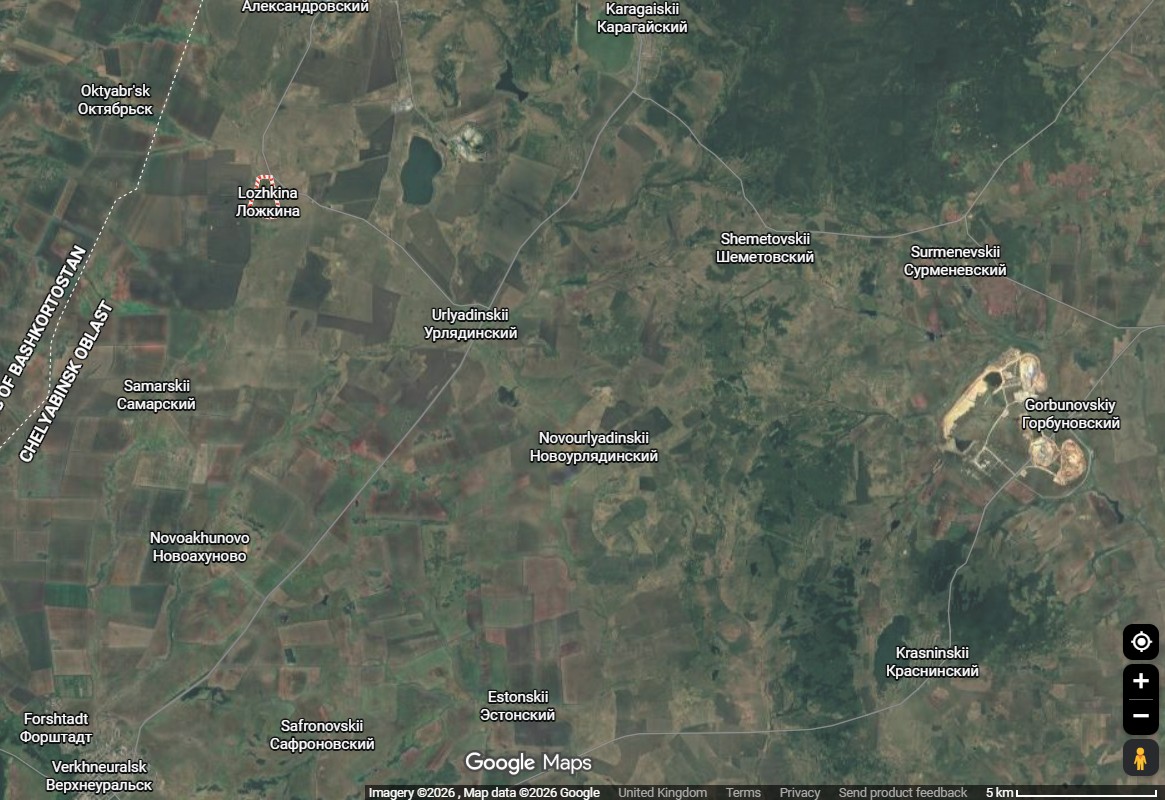
Map showing Lozhkin where their farm was just south west of Karagaiskii:
https://www.google.co.uk/maps/place/Lozhkina,+Chelyabinsk+Oblast,+Russia,+457677/@54.0666046,59.141423,31275m/data=!3m1!1e3!4m6!3m5!1s0x43d061b9724c667f:0xb97ccea040c724f2!8m2!3d54.0649682!4d59.3078037!16s%2Fg%2F11h8f4phj1?entry=ttu&g_ep=EgoyMDI2MDgxMi4wIKXMDSoASAFQAw%3D%3D Map of Ingair - place of exile:
https://www.google.co.uk/maps/place/Ingair,+Tyumen+Oblast,+Russia/@58.6067683,63.4929614,888353m/data=!3m1!1e3!4m6!3m5!1s0x43a3b841f8689beb:0x4c9f4be1b3b053ee!8m2!3d58.6056859!4d68.769162!16s%2Fg%2F1hhlybgyl?entry=ttu&g_ep=EgoyMDI2MDgxMi4wIKXMDSoASAFQAw%3D%3D