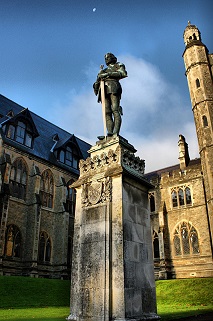
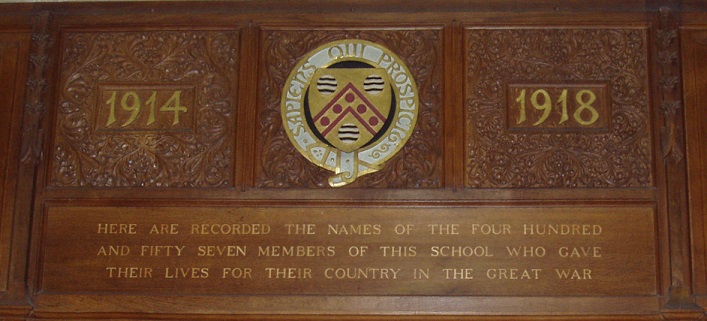
The following is a list with biographies of the 462 people who attended Malvern College and died due to the First World War. Altogether 2,833 are known to have served. There is also a corresponding page commemorating the 249 casualties in the Second World War.
There was not a month from August 1914 to November 1918 that an Old Malvernian did not become a casualty, with 6 killed on the first day of the Battle of Loos on the 25th September 1915 and 13 killed on the first day of the Battle of the Somme on the 1st July 1916.
The vast majority of casualties occurred in France and Belgium with 31 names recorded on the Menin Gate at Ypres, and 23 at Thiepval. There were also 23 casualties in Turkey due to the Gallipoli Campaign, and 16 in Iraq, including 2 near Kut.
They were in a wide range of regiments including 26 in the Royal Field Artillery, 13 in the Royal Engineers, 12 in the Worcestershire Regt, 11 in the Canadian Inf, 11 in the East Kent Regt (The Buffs), and 5 in the Royal Flying Corps and the Royal Air Force.
Most were officers with 133 Captains, 126 2nd Lieutenants, 114 Lieutenants, 26 Majors, and 15 Lieutenant Colonels.
29 received the MC, 10 the DSO and 1 the DCM, as well as 3 knighthoods (the CB, CMG, and MVO).
The information below is based primarily on the memorial books held at Malvern College which Ian Quickfall, and now Paul Godsland, the Malvernian Society archivists, have arranged to be digitised with the official memorial web site still in development.
Further information was also obtained from 'The Malvern College Register 1865-1924' edited by H.G.C Salmon, 'The Malvernian' school magazine, 'A History of Malvern College 1865 to 1965' by Ralph Blumenau, and 'Malvern College: A 150th Anniversary Portrait' by Roy Allen.
Information was also obtained from the Commonwealth War Graves Commission website, the Unit War Diaries and Service Records held at the National Archives in Kew, and various online commemorative websites whose links have been provided.
The main battles have tried to be identified in which Old Malvernians died in. Many though were killed in the general attrition of Trench Warfare which is so vividly described in the book 'Nothing of Importance' by Bernard Adams.
Below is a map showing the locations of the 246 cemeteries where Old Malvernians are buried or commemorated in. The markers are coloured yellow for one casualty, orange for between 2 and 9, and red for 10 or more. The name of the cemetery and number of casualties can be seen by hovering over the marker, and the list of names seen by clicking on the marker. Their full biographies and pictures can be seen by clicking on 'Further Info'.
The records can be filtered and/or sorted by name, house, age, regiment, battle, date, place etc by clicking on the appropriate drop down box and then the 'Search' button below the map. The original memorial book entry can be seen by clicking on the person's picture.
.jpg "View original memorial book page")
Son of Horace Arthur and Sarak Kate Fisher, Bramcote Hills,
Nott and Arno Vale, Notts. B. 1888.
Lower Shell - Upper V. House Prefect.
Clare College, Cambridge; B.A (Third class Law Tripos) 1908;
represented Cambridge University in Boxing; in British Columbia.
Great War, Private
British Columbia Horse 1914; 2nd Lieutenant 8th Batt Sherwood Foresters. Died of wounds.
'Geoffrey Fisher made many friends during his time at Malvern. He was somewhat old for his years, with ideas and opinions unusual in a schoolboy, at the same time he was very keen in all things connected with his house. He was in British Columbia when war was declared, and at once enlisted in the British Columbia Horse, but finding the regiment was not being sent on active service, he obtained a commission in the 8th Sherwood Foresters. He joined his regiment in France in August, and died of wounds on October 25th.' (Malvernian, Dec 1915).
He was wounded by a German grenade in both thighs and left arm during attacks at Hohenzollern Redoubt and died of wounds 25th October 1915, age 26, at No. 6 General Hospital, Etaples, France.
His younger brother Captain John Wilfred Fisher of the 10th Battalion The Sherwood Foresters also served and died during the 'Great War'
Biography at Nottinghamshire roll of honour Sherwood Foresters
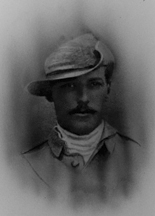
Son of Rev. Herman and Julia Friedlaender, of "Byfield," 16, Hurst Rd., Buckhurst Hill, Essex, formerly of Dulwich House, North Malvern. Born at Jerusalem.
Lower IV.
Mining Engineer in South Africa. South African War 1899—1902.
Captain, Brabant’s Scouts.
Great War, Private Smith African Horse.
'Since 1893 he had been in South Africa, chiefly engaged in gold mining. During the Boer War he served in Brabant's Horse and Kitchener's Fighting Scouts. He was one of the three officers selected by Colonel Grenfell for special service in the operations against Hertzog, Malan and Kritzinger in the Cape Colony, and later on against Beyer's in the Northern Transvaal. He left the Army at the end of that war with the rank of Captain and returned to mining work. He was employed for several years on the Knight's Deep property. At the outbreak of the present war he enlisted as a private in the South African Horse for service in East Africa, with the intention of coming to England at the end of that campaign and re-enlisting here. He, however, died of wounds received in action on October 25, 1916, in East Africa.' (Malvernian, Mar 1917).
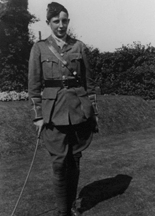
Son of H. O. Irvine, Southerndown House, Bridgend and of Mary M. Irvine, of 2, Salisbury Avenue, Penarth, Glamorgan, b. 1897.
Lower V—Lower VI. House Prefect.
London Matriculation.
Great War, Private Royal Fusiliers; 2nd Lieutenant R.F.C.
After leaving school he matriculated at London University, after which he was employed at a munition factory. He enlisted in the Royal Fusiliers in May, and got his commission in the Royal Flying Corps in July, and received his “wings” on September 28th. He was accidentally killed while flying in England.
Obituary in Flight Global magazine